
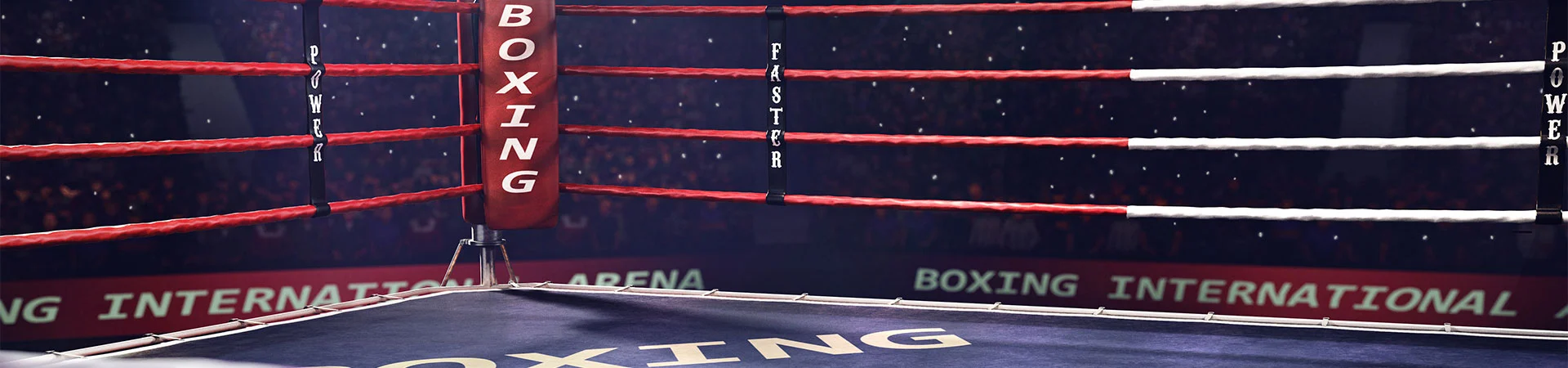
Deconstructing the Standard Boxing Ring: A Technical Breakdown (GB/T 34288-2017 & AIBA Standards)
Most people outside the combat sports industry simply see a boxing ring as nothing more than a square platform surrounded by ropes. But for event organizers, venue operators, gym owners, and equipment buyers, a professional boxing ring is precision-built sports equipment. Every dimension, every padded layer, and every welded joint follows strict industry rules — namely China’s GB/T 34288-2017 national standard and official AIBA competition requirements. These detailed specifications are not for formalities. They exist to guarantee athlete safety, overall structural stability, and full compliance for official matches and commercial use.
Below is a practical, layer-by-layer breakdown of how a genuine professional boxing ring is constructed.
1. Foundation & Elevation: Solid Support Structure
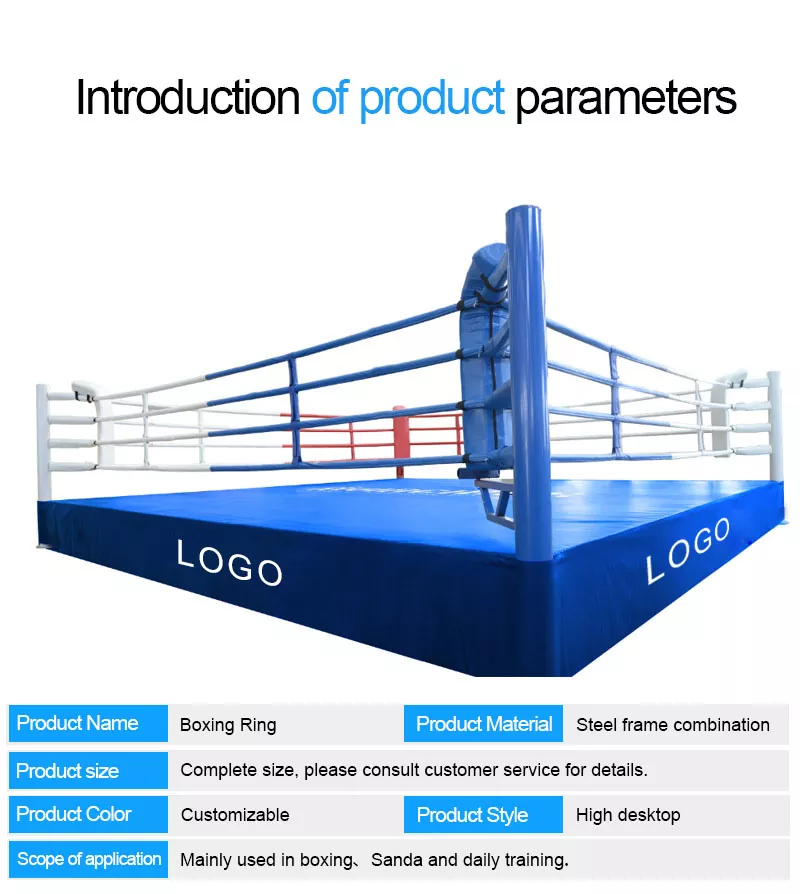
The raised platform design is the most recognizable feature of a professional competition ring. The standard height is fixed at 100cm (39.4 inches) above ground. This height is intentionally designed to deliver clear viewing angles for spectators, judges, and filming crews, while creating an independent, standardized competition zone for athletes.
The entire base is built with a fully welded square steel frame. Unlike ordinary bolted frames that easily loosen, shake or shift under strong impact, our integrated welded structure distributes pressure evenly across the whole platform. The frame stays completely rigid with zero bounce, zero flex and zero deformation, even during intense, high-impact fights. The empty space under the ring can be customized for storage purposes, though its core structural function is to remain stable and pressure-resistant — all shock absorption is handled by the upper platform layers.
2. Platform Deck: Multi-Layer Composite Structure
The steel frame forms the skeleton of the ring, while the multi-layer platform system delivers the perfect balance of sturdiness and cushioning. Many low-cost manufacturers skip detailed layer standards, but certified professional rings require strict adherence to every specification.
Directly installed on the steel frame is the hard base board, made of high-strength multi-layer plywood or density board. We select boards with excellent flatness and toughness. A board that is too soft will sink under the fighter’s weight and cause ankle injuries; a brittle board will crack after repeated impacts. Our base panels are specially chosen to resist dents, warping and long-term deformation.
On top of the base board sits the most critical safety component: the buffer cushion. We use a 15–20mm thick composite mat made of high-density rubber and felt, fully covering the entire fighting area. This layer absorbs most of the impact when athletes fall or get knocked down. It effectively disperses kinetic energy and greatly reduces risks of concussion, bruising and bone injury, fully meeting professional sports safety standards.
The outermost layer is a premium wear-resistant canvas cover. The standard competition blue color is widely adopted because it creates clear visual contrast with red/blue corner zones and helps referees easily identify cuts and bleeding during matches. The canvas is not loosely laid — it is fully stretched and tightly fixed to eliminate wrinkles and slippage. The finished surface is sweat-resistant, tear-resistant and non-slip, offering stable footing for continuous movement and intense fighting.
3. Safety Apron: Perimeter Protection Design
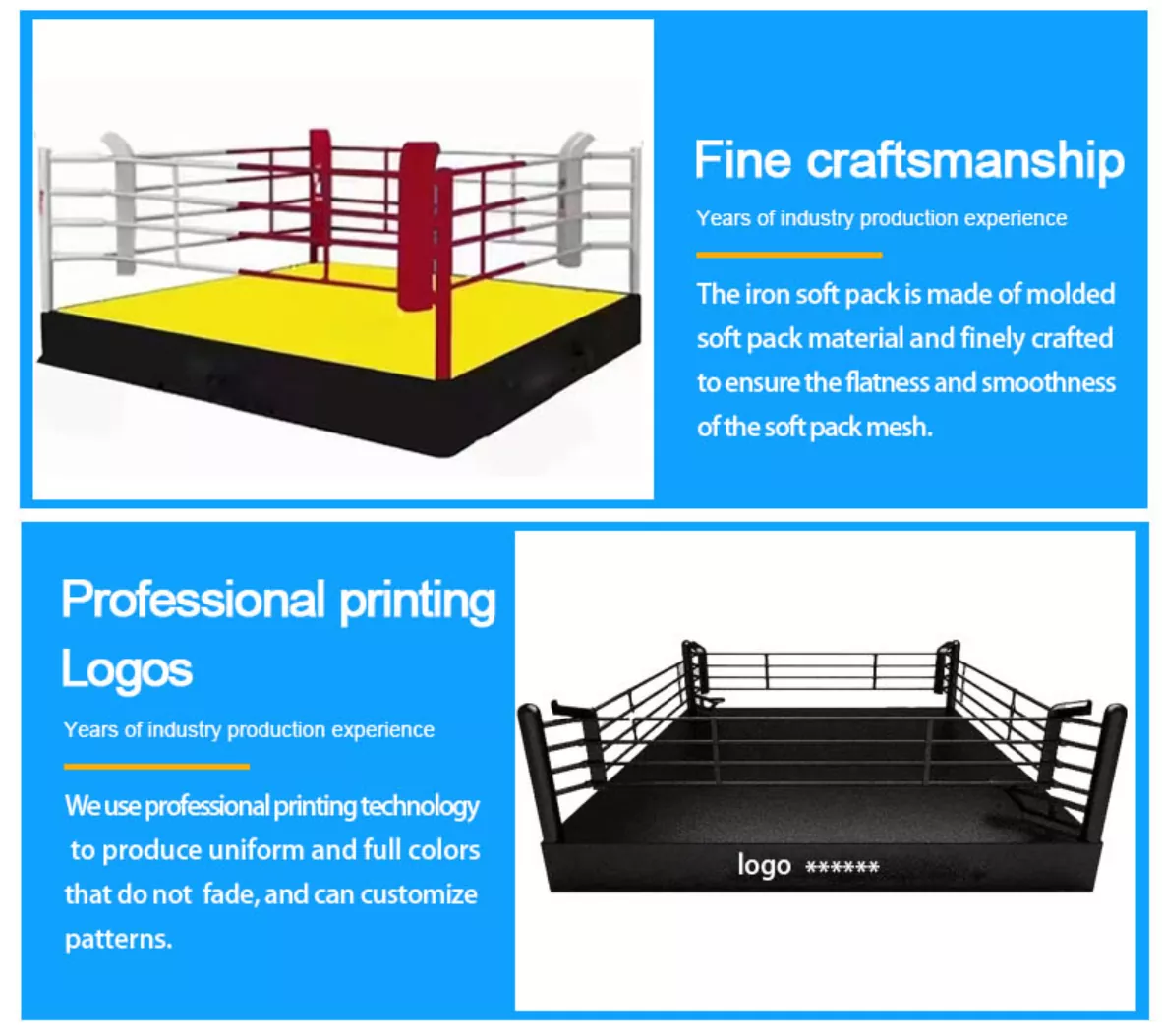
The outer apron extends 85cm outward from the fighting ropes on all four sides, bringing the ring’s overall outer size to 7.8m × 7.8m. This extended platform is a key safety feature. When fighters are pushed, staggered or driven toward the ropes, the wide apron prevents them from falling off the 1-meter-high platform to the ground. It acts as a reliable perimeter safety buffer for all competitions and training sessions.
4. Corner Posts & Functional Zoning Layout
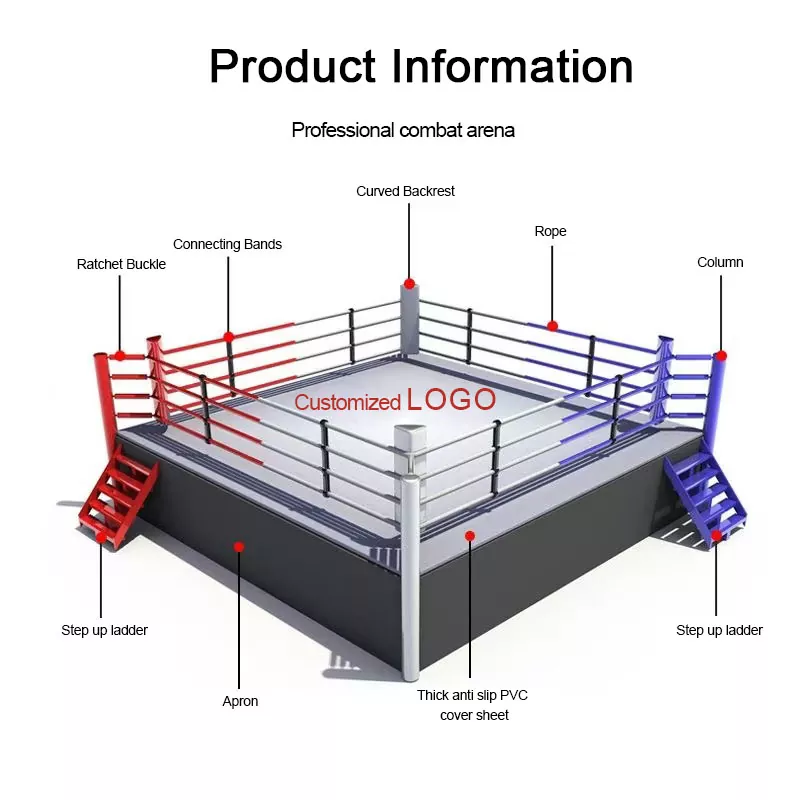
Four reinforced corner posts are installed at the platform corners, with a total height of 230cm — 130cm of which rises above the canvas surface. For safety reasons, all posts are set 35cm inward from the platform edge. This inward offset prevents athletes from directly hitting their head, neck or spine against hard steel posts when falling into corners.
The four corners are strictly divided into independent functional zones with clear purposes:
Red Corner: Positioned on the referee’s left side. It serves exclusively for the red-side athlete and coaching team, equipped with red anti-collision foam padding and an independent access staircase.
Blue Corner: Located on the referee’s right side, reserved for the blue-side athlete and team, with blue padding and dedicated steps.
Neutral Corners: The remaining two white corners are for referees and on-site medical staff only. Medical waste bags are hung here for used gauze and cotton supplies. These two corners have separate steps that are strictly forbidden for athletes and coaches to use.
All corner protective pads are 5–7cm thick and 20cm wide, with full surrounding soft foam coverage to deliver 360° anti-collision protection.
5. Four-Layer Rope System: Practical Safety Tension Design
The four-layer rope setup is one of the most practical yet underrated parts of a professional ring. Each rope measures 40mm in diameter and is wrapped with high-elastic soft fabric to avoid rope burns and soften collisions.
The vertical height of each rope layer follows fixed professional standards:
1st Layer (Lowest): 40cm above canvas
2nd Layer: 70cm above canvas
3rd Layer: 100cm above canvas
4th Layer (Highest): 130cm above canvas
The core advantage lies in our graded tension adjustment. Instead of applying equal tension to all ropes, we adopt a practical “tight top, loose bottom” setup via built-in post tension adjusters. The upper two ropes are tightly tensioned to form a firm boundary and stop fighters from falling out of the ring. The lower two ropes are slightly softer and more flexible, which cushions impact when athletes lean or get pinned against the ropes, effectively reducing rib injury and whiplash risks. Side rope tie straps further fix the four ropes as a whole, preventing separation and deformation during clinching and intense contact.
6. Three-Set Step System: Independent Access Design
Standard professional rings are equipped with three independent stair sets. Each step is 25cm high, designed according to ergonomic standards for stable and safe access.
Red Corner Steps: Exclusive for red team members.
Blue Corner Steps: Exclusive for blue team members.
Neutral Steps: Reserved only for referees and medical staff.
Independent access avoids on-site confusion, prevents unnecessary interference, and keeps match procedures standardized and orderly.
7. Standard Technical Specifications (Official Data)
Below are the official fixed dimensions for procurement, quotation and compliance verification:
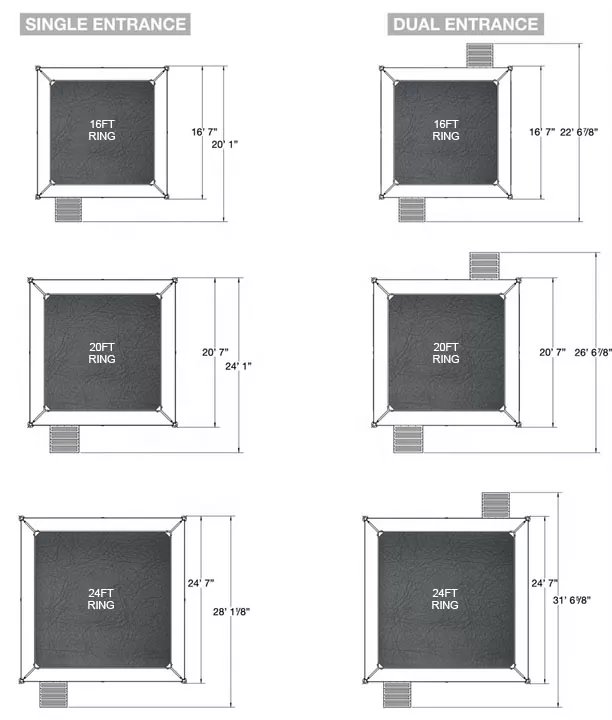
Inner Fighting Area: 6.1m × 6.1m
Overall Outer Platform Size: 7.8m × 7.8m
Platform Height from Ground: 100cm
Single-Side Apron Width: 85cm
Total Corner Post Height: 230cm (130cm above canvas)
8. Training-Type Boxing Ring (Gym Practical Version)
Compared with full professional competition rings, our training rings are optimized for daily gym use, balancing durability and cost performance. The inner fighting area ranges from 3m to 6.1m, and the platform height is reduced to 60–80cm for easier daily access. To save gym space, neutral steps can be omitted, and the rope tension system is reasonably simplified. Although not fully compliant with AIBA televised match standards, these training rings provide stable performance and reliable safety for daily training, sparring sessions and fitness courses.
Conclusion
A boxing ring is far more than a simple competition stage. It is a professionally engineered safety system built for long-term, high-intensity use. Whether you are purchasing equipment for official championship events or local boxing gym training, understanding these structural details helps you choose stable, safe and standard-compliant products that protect athletes and deliver lasting service life.